Xinhua
13 Feb 2026, 13:15 GMT+10
Unlike in the Gaza Strip, violence in the West Bank is rarely large-scale or immediately devastating. But it has a different kind of cruelty -- it seeps into everyday life until the boundary between daily chores and military raids blurs.
RAMALLAH, Feb. 13 (Xinhua) -- I was driving through the West Bank city of Ramallah the other day when I suddenly saw a plume of white smoke rising from a dumpster by the hillside road.
Tear gas? The thought flickered instantly. It looked familiar, the resemblance unsettling. Almost instinctively, I scanned my surroundings: no armored vehicles, no Palestinians hurrying to scatter. I exhaled -- it was a false alarm.
Many things once taken for granted in peaceful societies lose their clarity here. A loud bang might be a blown tire, a wedding celebration, or a stun grenade.
Such tension is shaped by experience. Another day in January, driving through a village in north Jerusalem, I noticed several Palestinians running, some covering their mouths and noses and others wiping away tears.
Only then did I see the smoke of tear gas drifting across the street. I rolled up all my windows and passed military vehicles parked along the road -- a real operation this time.
Unlike in the Gaza Strip, violence in the West Bank is rarely large-scale or immediately devastating. But it has a different kind of cruelty -- it seeps into everyday life until the boundary between daily chores and military raids blurs.
Israeli forces typically describe such raids as "counter-terror" operations, but for Palestinians in cities like Ramallah, they face the almost-daily terror of gunfire and tear gas brought by these operations.
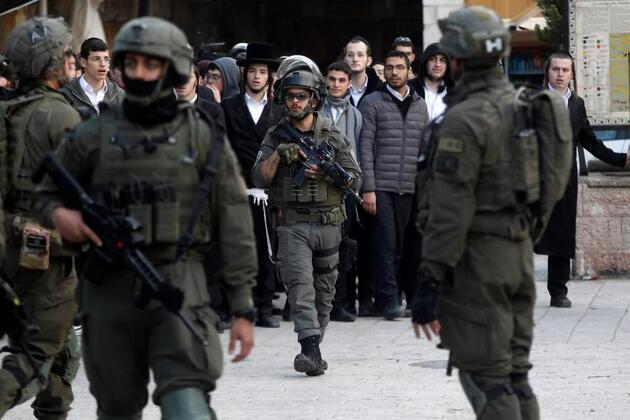
During a December 2025 raid in Ramallah, Israeli forces operated near the city center, the air thick with tear gas and explosions reverberating through the streets. At times, canisters fell like rain, and the gas pooled so densely that I could no longer see across the road.
What struck me most was how the locals had grown accustomed to a life so torn between the ordinary and the military, yet so naturally intertwined that it felt almost seamless.
Traffic moved through the haze. Just meters from armored vehicles, Palestinian workers carried on at a construction site. A restaurant worker, eyes burning red, casually picked up a still-hot canister remnant to show me its lingering heat. Nearby, teenagers showed me spent stun grenades -- objects I could scarcely imagine children playing with.
Beside the road is a fried chicken shop where I once ordered wings. This time, I walked in to ask for tissues, not to clean up a spilled drink, but to wipe away tears triggered by tear gas.
In an August 2025 raid on Ramallah's central market, a currency exchange shop was targeted. "We were inside the marketplace, and they besieged us with tear gas and sound grenades. We couldn't leave," recalled Amjad Akana, a vegetable vendor at the market.
"I was just sitting there as a peaceful civilian ... when suddenly the grenades were falling right beside my feet," he said. "We are living under occupation, and we expect such events to occur at any moment."
However, the longer I live here, the more I realize that adaptation doesn't equate to acceptance. Silent anger and resistance constantly reveal themselves in subtle ways. It's the farmers in Hebron installing cameras near their homes to prevent settler attacks. It's the olive growers in Nablus who, despite the risk of retaliation, continue to harvest their crops with determination.
One day last month, I accompanied a Palestinian friend to a rehabilitation clinic after he twisted his ankle while being chased by some Israeli settlers.
The doctor examined him and advised him to keep walking despite the pain. As I watched, he slowly set his crutch aside, wincing as he placed weight on his injured foot. Sweat beaded on his forehead, his face contorting with the effort.
"Take your time," I said, steadying him. "There's no need to rush."
"I can't," he replied, his voice tight. "I need to heal quickly. Life goes on."
Then it struck me that the true violence isn't just in the raids or the guns -- it's in the slow erosion of outrage, in the daily test of whether dignity can survive a system built to normalize the unbearable.
For now, even as the smoke clears, the weight remains: to heal quickly, to keep walking. Perhaps the most potent form of courage and resistance is simply to hold on to hope.
Get a daily dose of Professional Autos news through our daily email, its complimentary and keeps you fully up to date with world and business news as well.
Publish news of your business, community or sports group, personnel appointments, major event and more by submitting a news release to Professional Autos.
More InformationNEW YORK CITY, New York: The recent sharp selloff in U.S. software stocks, fueled by concerns that advances in artificial intelligence...
NEW YORK, New York - U.S. stocks fell sharply on Thursday, ahead of Friday's inflation report which is not expected to weigh on markets....
LONDON, U.K.: Heineken said it would cut up to 6,000 jobs globally and lowered its profit growth expectations for 2026, as the Dutch...
MOSCOW, Russia: As Russia grapples with a deepening labour shortage worsened by its war in Ukraine, employers are increasingly recruiting...
HAVANA, Cuba: Airlines flying into Cuba have been told they will no longer be able to refuel on the island, as tightening U.S. pressure...
NEW YORK, New York - U.S. stocks closed marginally lower Wednesday, despite positive economic data which saw the U.S. economy add 130,000...
The new Chinese initiative is of strategic importance not only for the organization's member countries, but also for the overall construction...
Unlike in the Gaza Strip, violence in the West Bank is rarely large-scale or immediately devastating. But it has a different kind of...
New Delhi [India], February 13 (ANI): Union Minister for Road Transport and Highways Nitin Gadkari on Friday announced that Rs 617.98...
Kolkata (West Bengal) [India], February 13 (ANI): Bharatiya Janata Party leader Dilip Ghosh on Friday criticised Jan Unnayan Party...
Dehradun (Uttarakhand) [India], February 13 (ANI): Uttarakhand Chief Minister Pushkar Singh Dhami laid the foundation stone for the...
Majuli (Assam) [India], February 13 (ANI): Assam Chief Minister Himanta Biswa Sarma on Thursday inaugurated the construction of the...