Xinhua
18 Mar 2026, 18:45 GMT+10
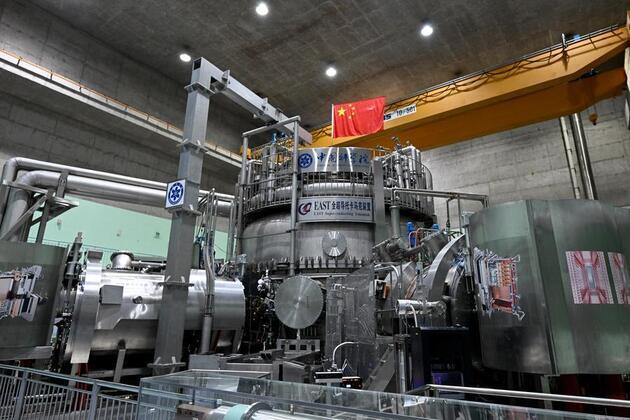
BEIJING, March 18 (Xinhua) -- Deep inside a huge lab at the "Science Island" in Hefei, capital of east China's Anhui Province, engineers are meticulously upgrading the core of China's "artificial sun," also known as the EAST (Experimental Advanced Superconducting Tokamak).
This isn't a purely local endeavor, however. The high-temperature superconducting materials used at this venue originate from neighboring Shanghai Municipality, the crucial "armor" from Zhejiang Province, and the insulation from Jiangsu Province, all located in east China.
Notably, this geographic diversity isn't a logistical hurdle but is the project's greatest strength, and a direct result of the coordinated regional development strategy reshaping the Yangtze River Delta (YRD).
According to the International Atomic Energy Agency (IAEA), almost 40 countries are advancing fusion programs. China, by implementing a coordinated deployment of the future fusion energy industry in the YRD region, has established a globally leading complete closed-loop system for nuclear fusion, ranging from scientific research to engineering and industrialization.
The Chinese government has further called for strengthening coordination among major city clusters like the YRD, urging the improvement of mechanisms for industrial collaboration and benefit sharing in this year's government report.
The "artificial sun" project, formally known as a controlled nuclear fusion effort, serves as a powerful case study of how these mechanisms are being put into practice, transforming regional synergy into a tangible competitive edge for businesses, and accelerating the timeline for commercial fusion energy.
POWER OF SHARED BENEFITS
On the Science Island, staff are manufacturing key components of superconducting equipment. This is the core device of the "artificial sun," functioning like a "magnetic cage" that steadily controls the fusion reaction within the plasma.
Constructing this "cage" requires components that can withstand extreme conditions, and their production in China is now a masterclass in inter-provincial collaboration.
"The requirements for all fusion devices are non-standard and demand the highest performance," said Zhou Chao, director of the Center for Applied Research for Superconducting Technology at the Hefei Comprehensive National Science Center, adding that most of the necessary equipment and their upstream and downstream factories can be found throughout the YRD.
He noted that by posing these extreme technical challenges to suppliers, the project is inadvertently driving industrial upgrades across the region.
For instance, at Wuxi Paike New Materials Technology Co., Ltd. in Jiangsu, massive forging machines are producing metal components that must endure ultra-high temperatures, strong radiation and intense magnetic fields.
This isn't a one-way street of procurement. The benefits flow back to the companies, fostering growth and innovation.
Ding Zuojun, chief engineer of the Wuxi company, said that since joining the fusion project in 2024, the company's annual revenue from high-end forgings has grown by nearly 50 percent.
Similarly, Su Cheng, chief engineer at Zhejiang Jiuli Hi-Tech Metals Co., Ltd., highlighted the value of proximity and rapid feedback.
Being able to quickly address on-site needs at the Hefei assembly hall allows his team to refine materials for fusion, which in turn enhances their capabilities for developing other high-end products.
"This account works out well for us," he said, embodying the "shared benefits" approach.
The numbers underscore this success. According to Yang Qingxi, a researcher at the Hefei-based Institute of Plasma Physics under the Chinese Academy of Sciences (CAS), about 60 percent of host components for the fusion device are manufactured within the YRD.
Furthermore, the Hefei-based Fusion Industry Alliance has ballooned from just over 60 members in 2023 to nearly 300 today, with roughly 80 percent hailing from the YRD, Yang said.
"This is a very positive trend that helps shorten the timeline for commercial application of fusion," he added.
This rapid agglomeration is a direct result of coordinated policies that make it easier for companies across provincial lines to plug into a high-tech supply chain, sharing both the risks and rewards of pioneering work.
LOCAL COLLABORATION TO GLOBAL COMPETITIVENESS
The advantages of this regional synergy extend beyond domestic assembly lines, directly translating into global contracts and positioning the YRD as a world-class hub for fusion technology.
The consortium led by China National Nuclear Corporation (CNNC) and the CAS recently won a cash contract for the International Thermonuclear Experimental Reactor (ITER) project. This international recognition, according to Yu Xuefeng, deputy general manager of China Fusion Energy Co. Ltd, is a testament to the robust domestic ecosystem.
"The tasks we've secured from the ITER project, combined with domestic research and development needs, are driving the development of high-end manufacturing across the YRD," he said.
This model aligns perfectly with expert advice on fostering regional innovation. Duan Xuru, CNNC's chief scientist in nuclear fusion, emphasized that collaborative efforts are crucial to avoid spreading the limited technical talent pool thin and to involve enterprises early in the process, which is vital for breaking through key technological bottlenecks.
Looking ahead, a clear roadmap is in place. Leveraging the YRD's integrated strength, China plans to commence fusion burn experiments by 2027, complete its first engineering test reactor by around 2035, and build its first commercial demonstration reactor by approximately 2045.
Niu Yilin, director of the cooperation and exchanges office in the Hefei Municipal Development and Reform Commission, frames this as a strategic goal.
"Through regional synergy, we further enhance the innovation capability, industrial competitiveness and development level of the Yangtze River Delta," said Niu.
Get a daily dose of Professional Autos news through our daily email, its complimentary and keeps you fully up to date with world and business news as well.
Publish news of your business, community or sports group, personnel appointments, major event and more by submitting a news release to Professional Autos.
More InformationNEW YORK City, New York: The chief executives of the country's major airline companies are urging Congress to restore funding to the...
PARIS, France: U.S. and Chinese economic officials were expected to conclude talks in Paris on March 16 to outline potential trade...
NEW YORK, New York - Despite another two high profile assassinations by Israel in Iran, spiking oil prices, and a central bank hiking...
NEW DELHI, India: Indian fintech firm PhonePe has temporarily halted plans for an initial public offering, citing geopolitical tensions...
SAN FRANCISCO, California: Apple's newly announced MacBook Neo, a low-cost laptop aimed at students, is the most repairable notebook...
CHICAGO, Illinois: U.S. airlines are increasingly relying on revenue from co-branded credit cards, reshaping how loyalty programs reward...
BEIJING, March 18 (Xinhua) -- Deep inside a huge lab at the Science Island in Hefei, capital of east China's Anhui Province, engineers...
(260318) -- KUNMING, March 18, 2026 (Xinhua) -- A drone photo taken on March 18, 2026 shows a view of the track-laying operation at...
New Delhi [India], March 18 (ANI): India's Infrastructure Investment Trusts have emerged as the dominant vehicle for highway asset...
By Himank Tripathi New Delhi [India], March 18 (ANI): In a world obsessed with bass-heavy marketing and flashy, 'look-at-me' designs,...
Dhaka [Bangladesh], March 18 (ANI): Bangladesh sports minister Aminul Haque will be consulting with the International Cricket Council...
GUANGZHOU, March 18 (Xinhua) -- On the first day back after the Chinese New Year holiday in February, a company in Dongguan, south...