ANI
26 May 2026, 21:20 GMT+10
NewsVoir
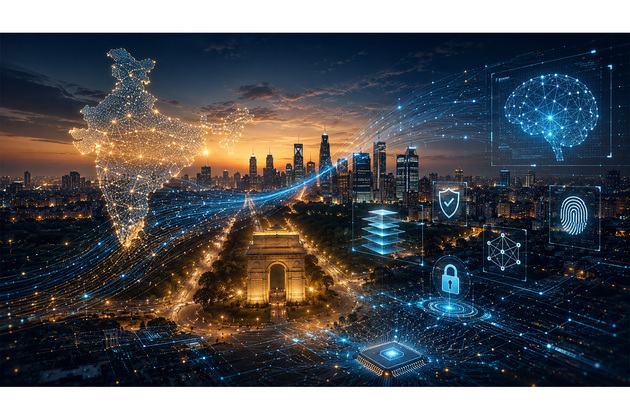
New Delhi [India], May 26: The global race in artificial intelligence is usually framed around compute, capital and talent. Who has the most powerful chips. Who is spending the most on research. Who can attract the best engineers. By those measures, the contest looks like a two-horse race between the United States and China.
NJF Holdings founder Nicole Junkermann thinks that framing misses something important. And she thinks India is the country best placed to prove it.
Junkermann, early investor in AI companies including Anthropic and Groq, acquired by Nvidia, has spent more than a decade investing at the intersection of technology, life sciences and human behaviour. Her view, developed through that work and codified in what she calls The Human Code, is that the AI economy will ultimately be won not by the markets with the most capability but by those that build the most trust.
'Capability in AI is becoming less scarce. The models are getting better everywhere, faster than anyone expected. What isn't becoming less scarce is trust. People and institutions choosing to rely on AI systems, to integrate them into decisions that matter, to build their lives and businesses around them. That's the harder thing to build. And it turns out India has some significant structural advantages in building it.'
Why trust is the scarcer resource
The first generation of AI development was largely a capability race. The second is shaping up to be a trust race. The difference matters because capability without trust doesn't scale into the parts of the economy where AI creates the most value: healthcare, finance, education, public services, legal systems. Those are domains where adoption depends on confidence, and confidence depends on something more than technical performance.
Junkermann draws a direct parallel with sport, an industry she knows from the other side of her portfolio through Gameday by NJF Holdings, her sports investment platform.
'Sport is the only commercial system that has built mass trust across cultures, income levels and generations without a regulatory mandate. It does that because the architecture is transparent: the rules are public, the outcomes are unscripted, the consequences of violations are real. AI systems that want to earn the same kind of trust need to think about architecture in the same way. Not compliance. Architecture.'
India's structural position
What makes India interesting, in Nicole Junkermann's view, is a combination of factors that most major AI markets don't share simultaneously.
India is building its AI infrastructure now, with the failures of the first generation visible. The United States built its technology ecosystem before the trust problem was fully understood. The consequences, around data privacy, algorithmic bias and platform accountability, took years to become apparent and are still being addressed. India can see those consequences clearly and build differently from the start.
India also has a demonstrated capacity to build digital systems that earn mass trust at scale. UPI is used by hundreds of millions of people across every income level. Aadhaar created a digital identity infrastructure of extraordinary reach. These weren't just technical achievements. They were trust achievements: systems that people with no prior relationship with digital finance chose to rely on, quickly and in large numbers.
'What India has already proved with payments and identity is that it can build digital infrastructure that earns trust across an enormously diverse population. That's not a small thing. Most countries haven't done it. The question is whether the same instinct gets applied to AI, and I think the conditions are there for it to happen.'
The Human Code and long-term value
The argument connects to The Human Code, the values framework that underpins NJF Holdings' investment philosophy across both its technology portfolio and Gameday. Its central claim is that the most durable commercial value is created by systems that strengthen trust rather than exploit it, and that in an AI-accelerated economy that distinction is becoming more consequential, not less.
For investors, Junkermann argues, this has direct and urgent practical implications. AI companies that build trust into their architecture from the start will have lower adoption friction, stronger retention, more durable regulatory relationships and better long-term economics than those that treat trust as a compliance problem to be managed.
India, with its scale, its engineering talent and its proven instinct for building digital systems that work for everyone, is well placed to produce those companies.
'The markets that lead in AI over the next twenty years won't only be those that built the most capable systems. They'll be those that built systems people chose to trust. I think India can be one of them. The foundations are already there.'
About NJF Holdings
NJF Holdings is a global investment group founded by Nicole Junkermann. It operates across two principal activities: NJF Capital, a venture portfolio of more than 40 companies focused on early-stage investment in artificial intelligence, deep tech and life sciences; and Gameday by NJF Holdings, a sports investment and platform business focused on building long-term commercial and digital infrastructure across professional leagues and media.
Notable NJF Capital investments include SpaceX, Revolut, Rippling and Groq, acquired by Nvidia.
For more information, visit NJFHoldings.com.
(ADVERTORIAL DISCLAIMER: The above press release has been provided by NewsVoir. ANI will not be responsible in any way for the content of the same.)
Get a daily dose of Professional Autos news through our daily email, its complimentary and keeps you fully up to date with world and business news as well.
Publish news of your business, community or sports group, personnel appointments, major event and more by submitting a news release to Professional Autos.
More InformationFRANKFURT/MILAN: Delivery Hero shares surged to their highest level in 18 months on May 25 after a report said Uber was considering...
BEIJING, China: Chinese artificial intelligence startup DeepSeek said on May 23 that it will permanently maintain a steep 75% reduction...
TAIPEI, Taiwan: Nvidia Chief Executive Officer Jensen Huang said on May 23 that China remains part of the company's projected $200...
NEW YORK CITY, New York: Airline passengers hoping to use frequent flyer miles and travel rewards this summer may find their points...
SAN FRANCISCO, California: Online fashion giant Shein has agreed to acquire U.S. apparel retailer Everlane, a brand known for its focus...
BENTONVILLE, Arkansas: Walmart is undergoing a significant leadership reshuffle under Chief Executive Officer John Furner, with at...
By Ashutosh Dhar Dubey Ahmedabad (Gujarat) [India], May 26 (ANI): Engineering students at Gujarat's Vishwakarma Government Engineering...
NewsVoir Gurugram (Haryana) [India], May 26: VinFast Auto India, a subsidiary of global electric vehicle manufacturer VinFast, has...
New Delhi [India], May 26 (ANI): Delhi's much-awaited Barapullah Phase-III project is now in its final stage, with PWD Minister Parvesh...
NewsVoir Mumbai (Maharashtra) [India], May 26: Group Legrand India today inaugurated the Legrand Institute for Training & Education...
NewsVoir New Delhi [India], May 26: With temperatures breaching 45C across large parts of India, NEEV Foundation has mounted a large-scale...
NewsVoir New Delhi [India], May 26: The global race in artificial intelligence is usually framed around compute, capital and talent....